Thursday, August 21, 2008

Building a Firewood Saving Stove


In Kiwangala the majority of the village can only afford to cook on firewood or coal. Recently, collecting firewood has hurt the area's environment. The primary 7 class has built a firewood saving stove at headmaster Moses Kiwala’s home as a demonstration to the community. They have designed the stove out of bricks and clay so that wood burns more efficiently.

Below is a description of how CSH built their model stove:


This is a tea kettle set to boil in the existing cooking area. It was not much more than a campfire.


The students first dug a shallow pit, six inches deep, adjacent to the wall of the cooking wall. The depression was three feet long by two feet wide; the expected area that the stove would sit upon. Bricks were then stacked into place to create the general shape of the stove.


The new stove has two top burners for sauce pans. A passage way connecting the two opennings allows heat to circulate within the stove. There is also a small ventilation hole poked into the back wall that also promotes heat flow.


This is the hole where firewood is fed lengthwise one piece at a time into the stove. The bricks retain the heat so very little wood has to be burned for the stove to get hot.


Local clay was mixed in water and then used as mortar to fasten the bricks permanantly into place. Then the entire stove was covered and sealed with the leftover clay. The stove had to dry for about a week before it was ready to be used. However, that didn't stop the Primary 7 class from celebrating immediately after construction was complete.


Uganda's Ministry of Energy has also produced several good designs for firewood saving stoves. You can find them here.

Wednesday, August 20, 2008

Farmers’ Update


The farmers of Lukindu village are getting ready for August’s planting season. Before dawn, every Friday they drowsily meet at the village borehole to fill up their jerrycans and then trudge up the hill to John Ssentongo’s model farm to irrigate the fourteen nursery beds that they have planted.

The farmers have combined their skills and efforts into a co-op where they will share their agricultural knowledge and reap the fruits of their labors.

The seeds sowed include cabbage, tomatoes, carrots, peppers, onions, eggplant, greens, and flowers.
They have been experimenting with a variation of designs to fully utilize the strength of the soil. Most seeds were planted in traditional rows bordered by banana tree trunks and shaded from the sun by banana leaf shelters. Some plants will be grown circularly around a dirt hill with a manure-centered cap. Water is poured over the top and runs down the side to provide a nutrient rich snack to the seedlings.

They will donate the seedlings grown in Children Sure House’s nursery beds to 15 families in September. The benefiting families will be instructed in nursery bed care, receive the harvest, and learn seed saving techniques to sustain their nurseries for future planting seasons.

Saturday, August 9, 2008

Ambrose and Tony


Two of Children’s Sure Houses’ teachers will not be coming back this semester. They have left Kiwangala for Kampala to further pursue higher education. Both Tony Ssali and Ambrose Kasiita will be studying at Kyambogo University. Ssali will be earning his B.A. in Economics. Kasiita will pursue his Bachelor's in Development Studies. They have been with the school from the beginning. They were the pioneering class of primary students that came to class when CSH first opened its doors in 1993.


Kasiita’s father died of AIDS in 1988. His mother managed to teach him the essentials of Primary 1 and 2 from home, but could not afford to send him to a real school. Likewise, Ssali’s family was too impoverished to pay school fees.


“After my father died, I really wanted to study.” Remembers Kasiita. “When the chance came that Children Sure House was offering free education God was answering my prayers.”


Kasiita had shown so much promise in Primary school, but at the time CSH had no Secondary section. Fearing that Kasiita’s potential would be wasted, headmaster Moses Kiwala personally tutored him while they waited for the Secondary school to be constructed.


Kasiita and Ssali eventually completed their Primary and Secondary studies at Sure House. Kasiita’s Economics in "Uganda Ministry of Education University Qualifying Exam Paper 1" received the highest score in the entire country.
After graduation they returned to teach.

“ I couldn’t have left Sure House because I had been helped,” said Ssali who has been teaching Primary and Secondary school since 2006.

Kasiita started teaching Primary school and Secondary Religion classes since 1999. He was promoted to head teacher in 2003.

Both teachers aspire to return to Children’s Sure House and Kiwangala village when they graduate from University. Ssali wants to continue to develop the CSH organization economically. Kasiita also has similar plans.

“We need to develop here.” Said Kasiita. “If we, the people who have been here in Kiwangala for many years can engage ourselves, we can bring the right stuff. They gave me free education so I needed to help the people in the villages with no money and who have lost a parent like I have.”

“I have Sure House on my heart,” added Ssali.

Godfrey's Solar Dryer


Godfrey Katamba, a Senior 3 student at CSH sells snacks to other students from his canteen. He's more than just an entrepreneur and definitely more than a teenager with an after-school job. At a young age he lost both of his parents and two of his siblings to AIDS. Godfrey’s canteen allows him to support himself as well as his brothers and sisters.

Some of Godfrey’s most popular items are sweet bananas. However, they don’t always get eaten in time and he has to throw them away. That is until now. Godfrey has developed a solar fruit dryer that uses the sun to preserve his left over fruit for quite some time.


Below are plans for a solar dryer like Godfrey’s.


Friday, May 30, 2008

The Seeds Have Been Planted


This past Sunday, the fruits and vegetables planted by the students in the Children’s Sure House nursery were ready to be transplanted. It seemed only fitting that members of the community’s local church be the first recipients. Cabbage, carrot, and melon seedlings were given to seven families. The progress of the plants’ livelihood will be followed closely by CSH as part of its Home Sustainability initiative.

The program is meant to introduce more variety of nutrition into the village of Kiwangala. By donating plants to its neighbors and then tracking their growth, CSH hopes to create a new network of farmers. The group will be instructed on new methods of agriculture CSH’s model farm.


Thursday, May 8, 2008

A Model Farm


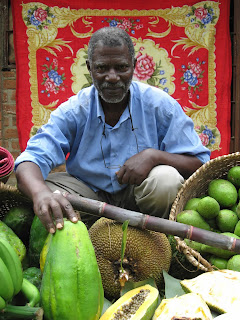
John Ssentongo’s home in Lukindu-Kiwangala, Uganda has been called a Garden of Eden. The fruit is in such abundance that it is literally falling off the trees. Anyone who visits Ssentongo, a key player at Children’s Sure House, is expected to take home with them as many avocados and papayas as they can carry.
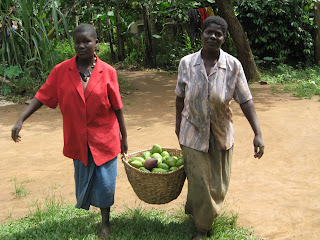
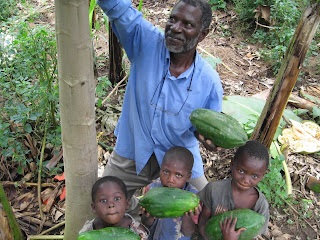

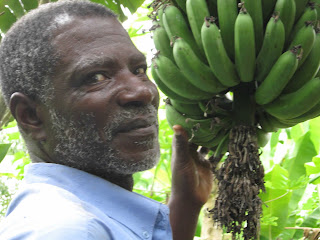
While most Ugandans have subdivided and sold off their land, the Ssentongos have been farming the same five acre plot since the 1950s. The homestead is completely self-sustainable. It provides the majority of food for the family. The surplus generates income, feeds the students and teachers at CSH, and supports the diets of his neighbors.

Ssentongo is keenly interested in developing his property into a model farm where members of the community can come to exchange ideas on better agricultural practices. Below is an overview of Ssentongo’s proposal.
The Program

The Home Sustainable Living Approach Program is an initiative of Children’s Sure House to lead homes, the community in its operational area, and Uganda at large to sustainability.

CSH works to create self-sustainability in the country by harnessing the potential of individuals to develop themselves, their households, and their communities. CSH partners with groups at all levels, including local, national, and international organizations, in the developmental process.

Objectives:

1. To improve food security through introducing new techniques of farming and other income generating activities. Income generation schemes are demonstrated to the community to empower them with knowledge and inspire them to create their own projects.

2. To provide consultancy services to community groups and individuals in their efforts to attain socioeconomic development. CSH will carryout and promote research on government programs, development agencies, and civil society programs that influence policy formulation.

3. To offer technical services in the fields of environmental protection, and agricultural development.


Home Sustainability
The Home Sustainability Program is intended to transform homes through farming, environment conservation, income generating activities, and education. The program will be demonstrated in model homes throughout the community.

Farming:
Most homes in Uganda depend entirely on agriculture for food consumption and income. Currently, many families eat only once a day. The meal usually consists solely of matoke, a type of plantain banana, or posho, a cornmeal product. Other vegetables must supplement staple foods to create sufficient nutrition. Better farming methods must be put into place.

Seasonal staple foods and cash crops must grow alongside long life fruit trees such as jackfruits, avocados, papaya, mangoes, and oranges. Homes must be encouraged to grow a nutritional variety of vegetables. Improved breeds of plants and animals must be introduced to farms to stimulate higher production. Organic farming and agroforestry should be applied to preserve the fertility of the environment. Better irrigation systems and affordable methods of water harvesting should be introduced. Produce preservation and value methods should be practiced to completely capitalize on the harvest.

Environmental Conservation:
Human activity has tempered the environment causing harsh climate changes. Steps must be taken to bring back a safer environment. Deforestation has contributed to global warming and soil erosion. New trees must be planted and firewood-saving stoves should be used; use of chemical fertilizers and over grazing should be discouraged.

Home Small Scale Industries and Income Generating Projects:
Daily expenses of basic household items burden homes. If there is knowledge of soap, candle, and cooking oil production, then families will have a better chance of sustaining themselves. If a surplus is created, then the products can bring additional income. To maximize profit, income generating projects will use locally available, raw materials.

Home Sustainability Living Approach Program-
Proposed Demonstration Model Home at Lukindu Kiwangala


Size of the Land: 5 Acres
Agricultural Division of Land:
1. Farmyard: ½ acre. This area is occupied by houses and a compound. The compound will be used for box gardening and other demonstrations that could be used in an urban environment.

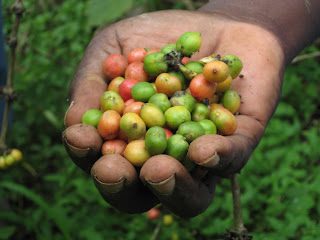
2. Coffee and Banana Plantation: 2 acres. Coffee and bananas will be maintained by agro-farming fruit trees such as avocados, jackfruits, and bark-cloth trees. In addition, ten beehives will be kept there.

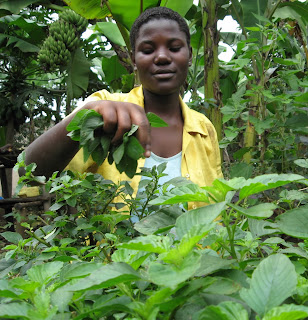
3. Vegetables and Other Seasonal Crops: 2 acres. Vegetables such as pumpkins, cabbages, carrots, eggplants, green pepper, onions, corn, cassava, sweet potatoes, and other seasonal crops will be grown. Their seeds will be harvested so that the surrounding community can partake in the next planting season.

4. Fish Pond: ½ acre. When construction is completed, local fish will be farmed here.
How to Build a Tippy-Tap


Many community members in rural Uganda suffer poor health because they do not possess the knowledge of adequate hygiene. Serious illnesses can easily be halted with simple prevention strategies. Washing hands with soap and water, especially after using the toilet, is one of the most effective ways to stop the spread of disease.

In Kiwangala, where Children’s Sure House is located, the toilets are basic pit latrines and there is no access to running water. The combination creates a thriving breeding ground for shigella, campylobacter, amebiasis, giardia, and even intestinal worms. These bacterial and protozoan complications are serious enough on there own, however, a high population of Kiwangalans' immune systems are already compromised by HIV. The consequences of infection could be potentially devastating.

The Senior 3 class at CSH has decided to do something about the problem. They are building 20 low-cost hand washing stations, called Tippy-Taps, outside many of the latrines in the community. The structure is a post and lentil design with a small plastic jerrycan that hangs off the top beam. It is called a Tippy-Tap because when the jerrycan tips over water comes out and the user can wash his or her hands. A Tippy-Tap can be made cheaply and easily by recycling available materials found in the community.


Here’s How to Build a Tippy-Tap:

Materials- A jerrycan with a handle (a jerrycan is a plastic container used to hold cooking oil, motor oil, or paint), 2 pieces of wood for posts (approximately 1.5 meters long and 7 centimeters thick, a piece), 1 stick of wood to hang the jerrycan from (approximately 1 meter long, 2 centimeters thick), 1 stick of wood (same size) that will act as a foot pedal, a sturdy string or clothesline (1 meter), nails, two plastic bags, some medium-sized rocks, a small piece of wire (1/2 centimeter), and an old plastic margarine container.

Tools- A saw, a shovel, a hammer, and a knife.

Directions-


  1. Start out by digging 15 centimeter holes for the posts to sit in. Space them about ½ a meter apart from one another.

  2. Cut the wood to the post’s desired length, wrap the bottom parts with the plastic bags (this prevents the wood from rotting) and then put them in the ground. Fortify the stability of the posts by filling in the remaining space empty space in the holes with a mixture of rocks and dirt.

  3. Next, unscrew the lid of the jerry can and poke a hole in the top large enough for the string to pass through. Tie one end of the string to the wire. Thread the string through the hole so that the wire sits snuggly in the underside of the lid.
    Poke a hole about ¾ up the side of the jerrycan opposite of the handle. This is the spout where the water will come out.

  4. Slide one of the slender pieces of wood through the handle of the jerrycan. Make sure that it can rock back and forth in the middle of the beam. If the stick is too big, whittle it down. Nail one side of the beam into the top of one of the posts so that the spout is facing you. Don’t nail the other side of the beam directly into the remaining post. Instead, hammer in two nails on either side of the beam. Leave enough space in between the nails so that the beam can be lifted up and the jerrycan can be removed periodically for cleaning.

  5. Cut the top half of the margarine container off. Punch many holes through the bottom half and then nail it to the top of one of the posts. This is a soap holder. The holes in the bottom will drain water from the rain.

  6. Dig a trench about ½ a meter and 1/3 meter deep long under the bottom of the posts and fill it with rocks. This will prevent the ground from eroding.

  7. Finally, screw the lid back on the jerrycan and tie the end of the string to the remaining stick. Fasten it in a way that the tied end of the stick is lifted 7 ½ centimeters off of the ground. Step down on the stick, allowing the jerrycan to tip forward, and place your hands under the spout to wash them.


Here are some other Tippy-Tap resources on the Web:
The IRC International Water and Sanitation Centre provides some more background on the benifets of Tippy-Taps.
Tearfund International Learning Zone describes how to build a Tippy-Tap with strings instead of posts.
This is a video showing another Tippy Tap invention.